
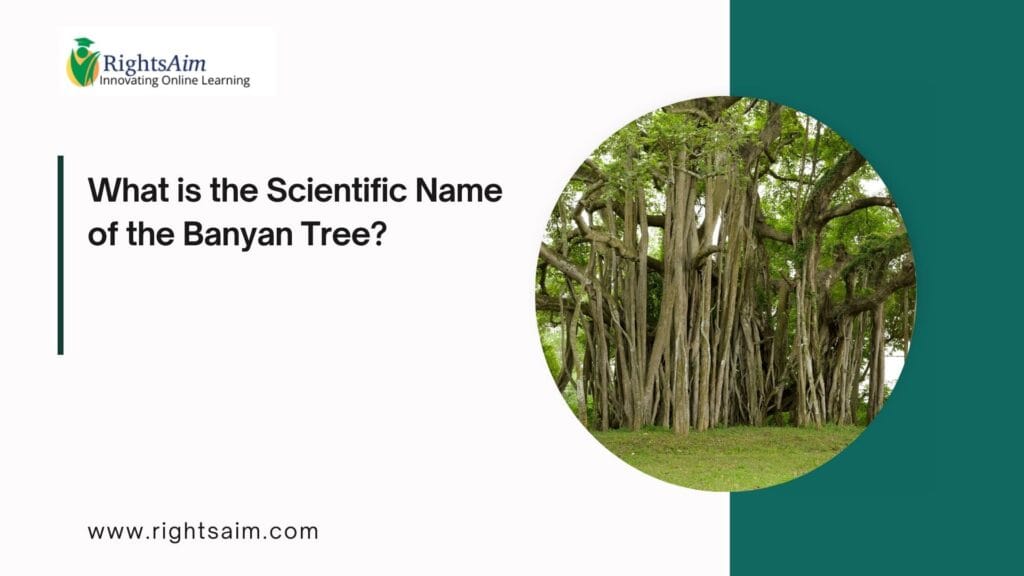
The Banyan tree, one of the most majestic and iconic trees of India, holds immense ecological, cultural, and scientific significance. Often seen spreading its wide canopy with aerial roots hanging like pillars, this tree is not just a botanical wonder but also a sacred symbol in Indian traditions. Scientifically, it belongs to the genus Ficus, which includes hundreds of fig species found around the world. The scientific name of the Banyan tree is Ficus benghalensis.
In this detailed article, we will explore the scientific classification, features, importance, habitat, uses, and cultural significance of the Banyan tree — along with interesting facts about this “Tree of Life.”
🌿 Scientific Classification of Banyan Tree
| Category | Details |
|---|---|
| Kingdom | Plantae |
| Division | Magnoliophyta |
| Class | Magnoliopsida |
| Order | Rosales |
| Family | Moraceae (Mulberry family) |
| Genus | Ficus |
| Species | Ficus benghalensis |
Thus, the scientific name or binomial nomenclature of the Banyan tree is Ficus benghalensis, where:
Ficus refers to the fig genus that includes more than 800 tropical and subtropical species.
benghalensis indicates that the species was first identified in the Bengal region of India.
The name was assigned by Carl Linnaeus, the father of modern taxonomy, who observed this tree’s wide distribution across the Indian subcontinent.
🌳 General Description of Ficus benghalensis
The Banyan tree is known for its enormous size and complex structure. It can spread across several acres and live for hundreds of years. Here are its major features:
Roots:
The tree develops aerial prop roots that grow downwards from branches and anchor into the soil, forming new trunks.
Over time, these roots give the tree the appearance of multiple trees growing together.
Leaves:
The leaves are large, leathery, and oval-shaped with a smooth margin.
They are evergreen and provide dense shade, making the tree a natural shelter.
Fruits:
The Banyan produces small fig-like fruits, green when unripe and turning red when mature.
These fruits are consumed by birds, bats, and monkeys, which also help in seed dispersal.
Height and Canopy:
Banyan trees can grow up to 30 meters tall, with canopies spreading more than 200–300 meters wide in older specimens.
Some ancient Banyans have thousands of prop roots, creating a miniature forest ecosystem.
🌍 Habitat and Distribution
The Banyan tree is native to the Indian subcontinent but is now found in tropical and subtropical regions across the world.
Native Range: India, Bangladesh, Sri Lanka, Nepal, and Pakistan.
Introduced To: Parts of Africa, Australia, the Caribbean, and Southeast Asia.
Preferred Climate: Warm, humid, and tropical conditions with moderate rainfall.
Soil Type: Well-drained, fertile, loamy soil with plenty of moisture.
Altitude: Commonly found from sea level up to 1000 meters elevation.
It grows abundantly along roadsides, temple grounds, and open fields and is especially revered as a sacred tree in India.
🌱 Ecological Importance of the Banyan Tree
The Banyan tree plays a vital role in maintaining the balance of the environment and ecosystem.
Habitat Provider:
The tree provides shelter and nesting grounds for a wide range of species — including birds, bats, insects, and monkeys.
Air Purification:
It releases a large amount of oxygen and filters pollutants from the air, improving air quality in its surroundings.
Soil Conservation:
The deep and wide root system prevents soil erosion and stabilizes the soil structure.
Microclimate Regulation:
The vast canopy provides shade and cools the local environment, reducing heat and creating a natural microclimate.
Carbon Sequestration:
Banyans absorb large amounts of carbon dioxide, thus contributing to the fight against climate change.
🕉️ Cultural and Religious Significance in India
The Banyan tree is deeply rooted in Indian mythology, spirituality, and culture. It symbolizes immortality, wisdom, and fertility.
In Hinduism:
It is considered the abode of Lord Vishnu, and also associated with Lord Shiva.
The tree represents the Trimurti — roots as Brahma (creator), trunk as Vishnu (preserver), and leaves as Shiva (destroyer).
Women observe the Vat Savitri Vrat, praying under the Banyan tree for the long life of their husbands.
In Buddhism:
The Banyan is related to enlightenment — Buddha attained wisdom under a related species, the Ficus religiosa (Peepal tree).
In Village Life:
The Banyan is often planted near temples, schools, or village centers where people gather for meetings or rest under its shade.
💊 Medicinal and Economic Uses
Beyond its ecological and cultural value, Ficus benghalensis has various practical and medicinal applications:
Medicinal Uses:
The bark and leaves are used in Ayurveda to treat diabetes, ulcers, and infections.
The milky latex is applied externally to heal wounds and inflammation.
Wood & Bark:
The bark yields fibers used for making ropes and paper.
Latex:
Used in traditional remedies and sometimes for sealing material.
Shade & Ornamental Value:
Due to its vast canopy, it’s widely planted in parks, roadsides, and temple grounds for shade and beauty.
🌺 Famous Banyan Trees in India
The Great Banyan Tree, Kolkata (A.J.C. Bose Botanical Garden):
Covers over 3.5 acres; over 250 years old.
Thimmamma Marrimanu, Andhra Pradesh:
Recognized by Guinness World Records as the largest Banyan tree in the world, covering nearly 5 acres.
Kabirvad Tree, Gujarat:
Associated with Saint Kabir, spread over 2.5 acres on the banks of River Narmada.
🌳 Conclusion
The scientific name of the Banyan tree is Ficus benghalensis — a species that represents both nature’s engineering marvel and India’s living heritage. It is more than a tree; it’s an ecosystem, a cultural symbol, and a life-giver. From providing oxygen and shade to offering spiritual comfort and ecological balance, the Banyan tree continues to play an indispensable role in both human life and biodiversity.