
The Xavier Aptitude Test (XAT) 2026, conducted by XLRI Jamshedpur on behalf of XAMI, has been successfully held across examination centres in India. Thousands of MBA aspirants appeared for the exam with the aim of securing admission to prestigious management institutes such as XLRI, XIMB, IMT, TAPMI, SPJIMR (through XAT score), and other XAT member colleges. Soon after the exam, candidates are keen to know the XAT Exam Analysis 2026, including section-wise difficulty level, overall paper review, and good attempts.
Based on feedback from test-takers and expert analysis, the XAT 2026 paper was moderate to difficult, maintaining its reputation as one of the most challenging MBA entrance exams in India. This article provides a detailed section-wise analysis, expected cut-offs, and insights into good attempts to help candidates assess their performance.
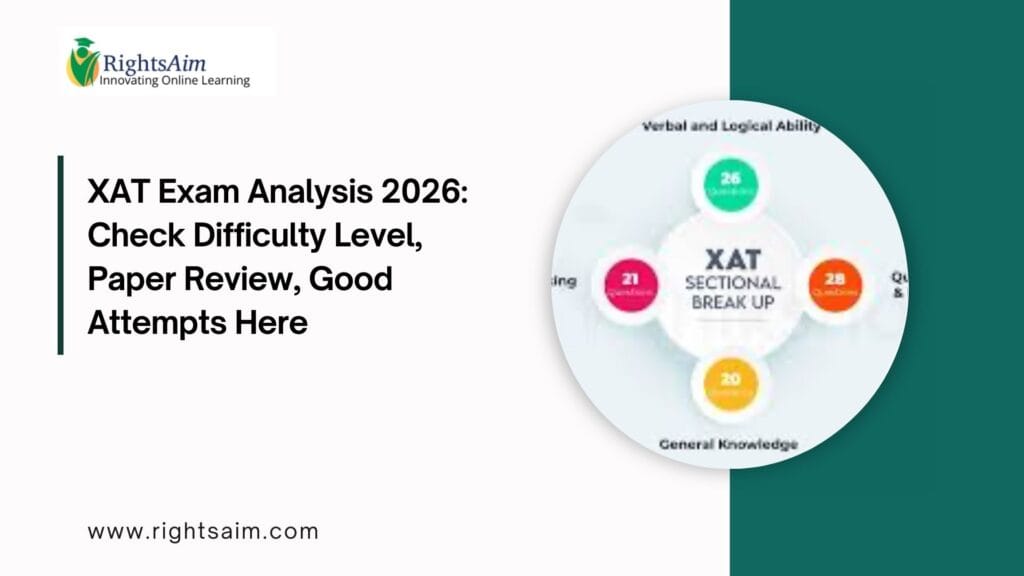
Table of Contents
XAT 2026 Exam Overview
The XAT exam is known for its unique sections, emphasis on decision-making skills, and analytical thinking. Unlike CAT, XAT tests candidates on real-life managerial scenarios and ethical dilemmas.
Key Highlights of XAT 2026
| Particulars | Details |
|---|---|
| Exam Name | Xavier Aptitude Test (XAT) |
| Conducting Body | XLRI Jamshedpur |
| Exam Mode | Computer-Based Test (CBT) |
| Duration | 3 hours 10 minutes |
| Total Questions | 100 (Part 1) + GK |
| Sections | VALR, DM, QA & DI, GK |
| Negative Marking | Yes |
| Official Website | xatonline.in |
Overall Difficulty Level of XAT 2026
The overall difficulty level of XAT 2026 was reported to be moderate to difficult, slightly tougher than XAT 2025. The Decision Making section remained the most distinctive and challenging part of the paper, while Quantitative Ability & Data Interpretation was time-consuming for many candidates.
The Verbal Ability & Logical Reasoning (VALR) section was moderate, with a strong focus on reading comprehension. General Knowledge was manageable for candidates who regularly follow current affairs.
Section-Wise XAT Exam Analysis 2026
1. Verbal Ability & Logical Reasoning (VALR)
Number of Questions: 26
Difficulty Level: Moderate
Key Topics Covered:
Reading Comprehension (4 passages)
Vocabulary-based questions
Critical reasoning
Para-jumbles and sentence correction
The VALR section tested candidates’ comprehension skills and logical thinking. Reading comprehension passages were slightly lengthy but manageable. Vocabulary questions were of moderate difficulty, focusing on contextual usage rather than direct meanings.
Good Attempts: 14–16 questions
Ideal Time Allocation: 45–50 minutes
2. Decision Making (DM)
Number of Questions: 21
Difficulty Level: Moderate to Difficult
Key Topics Covered:
Ethical dilemmas
Business and managerial scenarios
Social and organisational decision-making
The Decision Making section once again proved to be the game-changer in XAT 2026. Questions were scenario-based and required candidates to choose the most appropriate and ethical decision, rather than the most profitable one.
There were no negative marks for incorrect answers in some DM questions, but careful reading and logical judgement were essential.
Good Attempts: 10–12 questions
Ideal Time Allocation: 40–45 minutes
3. Quantitative Ability & Data Interpretation (QA & DI)
Number of Questions: 28
Difficulty Level: Difficult
Key Topics Covered:
Arithmetic (percentages, profit & loss, time & work)
Algebra
Geometry
Data Interpretation (tables, charts, caselets)
The QA & DI section was lengthy and calculation-intensive. Arithmetic questions dominated the section, while DI sets required careful interpretation and time management. Many candidates found this section challenging due to complex calculations and multi-step problems.
Accuracy played a crucial role, as negative marking could significantly impact the score.
Good Attempts: 10–12 questions
Ideal Time Allocation: 50–55 minutes
4. General Knowledge (GK)
Number of Questions: 25
Difficulty Level: Moderate
Key Topics Covered:
Current affairs (national and international)
Business and economy
Static GK
Awards, books, and personalities
The GK section was relatively straightforward for candidates who regularly read newspapers and followed current events. Questions were well-balanced between static GK and current affairs.
It is important to note that GK marks are not included in the final percentile, but they are considered by XLRI during the interview stage.
Good Attempts: 12–15 questions
Ideal Time Allocation: 15–20 minutes
XAT 2026 Good Attempts (Overall)
Based on the overall difficulty level, the expected good attempts for XAT 2026 are as follows:
| Section | Good Attempts |
|---|---|
| VALR | 14–16 |
| Decision Making | 10–12 |
| QA & DI | 10–12 |
| GK | 12–15 |
| Overall (Part 1) | 36–40 |
Candidates with high accuracy in this range can expect a strong percentile score.
Expected Cut-Off for Top Colleges (XAT 2026)
The cut-offs may vary depending on institute requirements, but expected cut-offs are:
| Institute | Expected Cut-Off |
|---|---|
| XLRI Jamshedpur (BM) | 94–96 percentile |
| XLRI Jamshedpur (HRM) | 92–94 percentile |
| XIMB | 90–92 percentile |
| IMT Ghaziabad | 90 percentile |
| TAPMI | 85–88 percentile |
Sectional cut-offs, especially in Decision Making, are crucial for XLRI admissions.
What to Do After XAT 2026 Exam?
After the exam, candidates should:
Check official answer key once released
Estimate raw score and percentile
Track cut-off announcements
Prepare for GD-PI-WAT rounds
Keep documents ready for interviews
Shortlisting for interviews is based on overall percentile, sectional scores, academic profile, and work experience.
Comparison with Previous Year (XAT 2025)
Compared to XAT 2025:
QA & DI was slightly tougher
Decision Making remained equally challenging
VALR difficulty level was similar
GK was balanced and predictable
Overall, XAT 2026 maintained the exam’s reputation for testing managerial aptitude over rote learning.
Conclusion
The XAT Exam 2026 lived up to expectations by offering a well-structured yet challenging paper that tested candidates on analytical ability, ethical judgement, and decision-making skills. With an overall difficulty level of moderate to difficult, success in XAT 2026 depended largely on accuracy, time management, and smart question selection.