
In a period of shifting global alliances and evolving geopolitical pressures, the bilateral relationship between Government of India and Government of Russia continues to showcase pragmatic cooperation and strategic alignment. The recent signing of the so-called “RELOS Agreement” — along with a high-level bilateral meeting between Narendra Modi and Vladimir Putin — underscores the resilience and depth of India–Russia ties. Below is an overview of the key outcomes and what they mean for both nations.
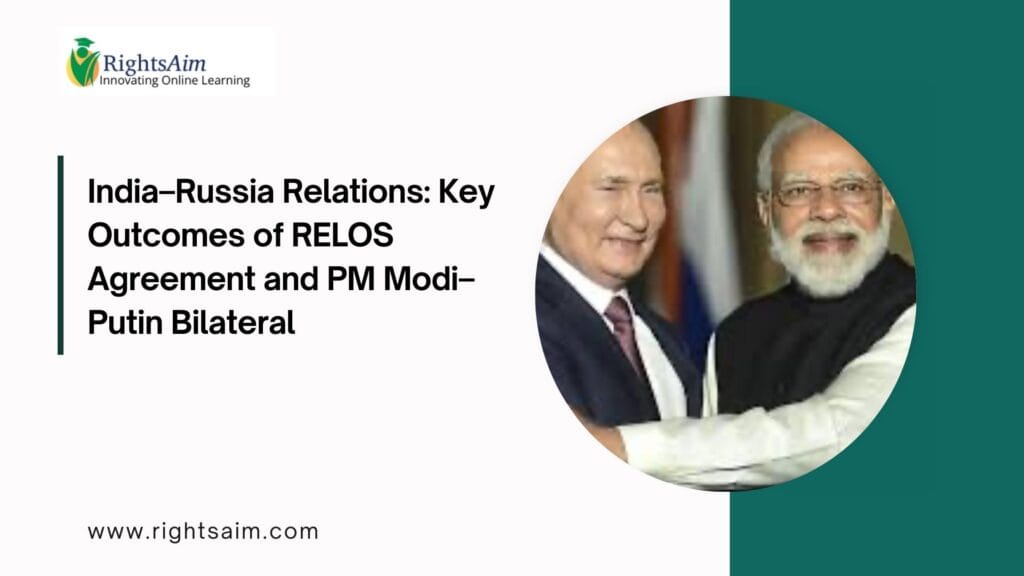
Table of Contents
🔹 What is the RELOS Agreement
The recently signed “RELOS Agreement” (short for Revised/Extended Logistics & Strategic Cooperation Agreement) between India and Russia signals a new phase of cooperation. Under this pact, both countries pledge to facilitate smoother logistical support and strategic coordination — covering areas such as:
Defence logistics and supply-chain support
Maintenance, repair, and overhaul (MRO) collaboration for military hardware and associated infrastructure
Joint use of strategic facilities (ports, airbases, maintenance depots) for mutual support
Enhanced intelligence sharing for counter-terrorism and regional security cooperation
The agreement aims to strengthen long-term defence ties and streamline operational readiness — recognizing that in today’s volatile global environment, strategic logistics and interoperability are as vital as procurement. The RELOS framework essentially updates previous cooperation accords, tailoring them to current geopolitical exigencies and technological requirements.
✅ Key Outcomes from the RELOS Agreement
Enhanced Defence Logistics & Readiness: India and Russia now have a formalized logistics roadmap for sustaining defence hardware, especially critical for long-term maintenance of equipment sourced from Russia. This reduces downtime and operational risks.
Strategic Infrastructure Access: Each side may get access to select strategic facilities — such as ports, airbases, or repair yards — thereby allowing flexible deployment, joint drills, and faster resupply if required.
MRO and Maintenance Collaboration: With rising reliance on advanced platforms (aircraft, naval vessels, electronics), the agreement emphasizes shared maintenance and overhaul capacities, potentially lowering costs and boosting reliability.
Strengthened Intelligence & Security Cooperation: Given overlapping security concerns — terrorism, regional instability, transnational threats — the RELOS pact includes enhanced information sharing protocols, which can better address common challenges.
Signalling Strategic Autonomy: By deepening cooperation with Russia, India reaffirms its independent foreign policy stance — projecting that it can pursue multiple partnerships without becoming overly reliant on any single bloc.
🤝 Highlights from the Modi–Putin Bilateral
During the recent visit between Modi and Putin, both leaders reaffirmed long-standing ties and underscored shared interests. Key takeaways from the bilateral include:
Commitment to Defence Cooperation: The two sides pledged continued cooperation in defence procurement and technology transfers, consistent with the broader goals of the RELOS Agreement.
Economic & Energy Collaboration: Beyond military ties, India and Russia discussed expanded cooperation in energy — including oil, gas, and even potential collaboration in renewable energy or nuclear energy sectors. Strengthening trade and investment was also emphasized.
Diplomatic Coordination on Global Issues: India and Russia agreed to coordinate positions on global hotspots, promote a multipolar world order, and jointly address emerging challenges — from regional conflicts to climate change and global economic instability.
Cultural & Educational Exchanges: Recognizing soft-power as a critical component of bilateral ties, both countries expressed interest in expanding student exchanges, academic cooperation, and cultural initiatives to deepen people-to-people connections.
Affirmation of Strategic Partnership for the 21st Century: The meeting concluded with a mutual declaration that India–Russia relations remain a “special and privileged strategic partnership.” Both leaders acknowledged the evolving nature of global geopolitics and committed to keeping their cooperation dynamic and future-ready.
🌐 Broader Implications
The RELOS Agreement and the Modi–Putin bilateral come at a time when global alliances are in flux due to tensions between major powers, economic realignments, and regional security challenges. For India, this signals:
Strategic Flexibility: By strengthening Russian ties alongside other global partnerships, India retains strategic autonomy, balancing relations with multiple blocs without locking into rigid alignments.
Defence Self-Reliance with Stability: Continuous maintenance-support collaboration under RELOS ensures that India’s defence readiness remains robust, especially for equipment dependent on Russian supply chains.
Influence in Regional Security Dynamics: With enhanced cooperation, India and Russia together may exert greater influence on regional issues — from Central Asia to maritime security in the Indian Ocean.
Economic and Technological Collaborations: Defence cooperation often dovetails with civilian industry and technological collaboration; MRO and logistics cooperation may lead to joint ventures in aerospace, shipbuilding, or infrastructure development.
For Russia, the agreement helps preserve a long-standing strategic partner and bolsters its relevance in Asia even amidst global pressure and shifting alliances.
✨ Conclusion
The RELOS Agreement and the Modi–Putin bilateral reaffirm that despite global volatility and changing power equations, the India–Russia partnership continues to adapt and evolve. By focusing on logistics, infrastructure, defence readiness, and broader cooperation beyond military hardware — including economy, energy, and diplomacy — both countries have charted a pragmatic, forward-looking path. As the global landscape becomes more unpredictable, such strategic depth ensures that India and Russia remain reliable partners for each other — ready to face challenges together and safeguard mutual interests in an uncertain world.