
If you are planning to study or work abroad, proving your English language proficiency is a key requirement. Among the most widely accepted English tests are IELTS, TOEFL, and PTE. While all three serve the same purpose, they differ in format, scoring, difficulty level, and acceptance. Choosing the “easiest” test depends largely on your strengths, test-taking style, and comfort with technology.
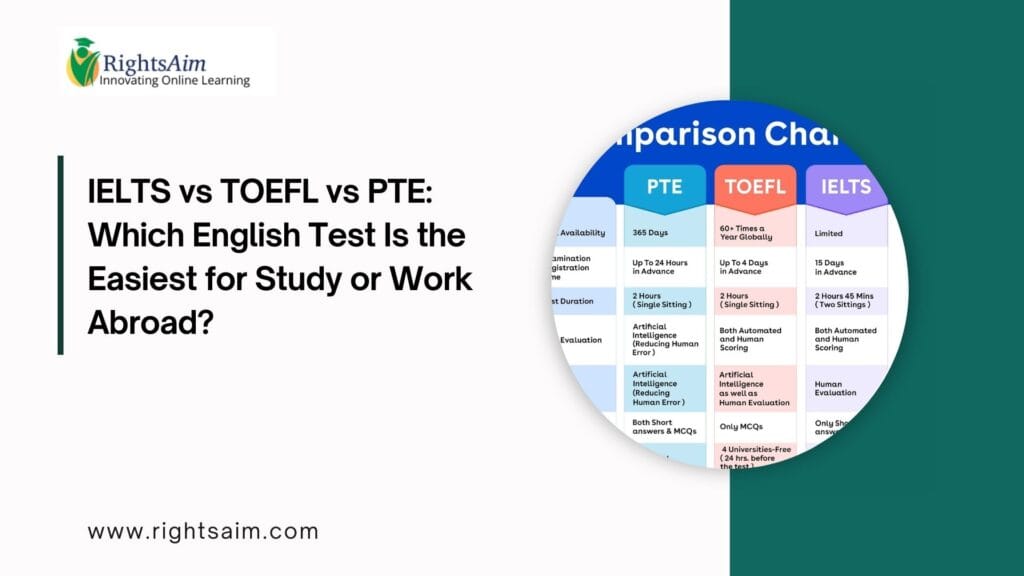
Table of Contents
🌍 IELTS (International English Language Testing System)
IELTS is one of the most popular English exams globally and is accepted in countries like the UK, Canada, Australia, New Zealand, and the USA. It is available in two versions: IELTS Academic (for study) and IELTS General Training(for work or migration).
The test evaluates Listening, Reading, Writing, and Speaking skills. One major advantage of IELTS is its face-to-face speaking test, which many candidates find more natural and less stressful than speaking to a computer. IELTS also offers paper-based and computer-based options, giving flexibility to test-takers.
However, the writing section—especially Task 2 essays—can be challenging and requires strong grammar and structure. IELTS scores are reported on a band scale from 0 to 9.
🇺🇸 TOEFL (Test of English as a Foreign Language)
TOEFL iBT is widely accepted by US and Canadian universities, as well as institutions in Europe and Asia. The test is entirely computer-based and focuses heavily on academic English.
Unlike IELTS, TOEFL does not include face-to-face interaction. The speaking section requires candidates to record answers using a headset, which some find uncomfortable. TOEFL’s reading and listening sections are longer and more academically oriented, which may be difficult for candidates not used to university-level content.
TOEFL scores range from 0 to 120, and results are valid for two years. TOEFL is often considered tougher for students who struggle with long reading passages or fast-paced listening sections.
💻 PTE (Pearson Test of English)
PTE Academic is a fully computer-based test and is increasingly popular due to its fast results, often available within 48 hours. It is accepted by many universities and immigration authorities, especially in Australia and the UK.
PTE is scored entirely by AI, reducing human bias. Candidates comfortable with technology and quick responses often find PTE easier. The integrated tasks (listening + speaking or reading + writing) can be efficient but challenging for beginners.
Scores range from 10 to 90, and the exam emphasizes speed, pronunciation clarity, and accuracy.
🏆 Which English Test Is the Easiest?
IELTS: Best for those who prefer human interaction and structured exams
TOEFL: Suitable for students strong in academic English
PTE: Easiest for tech-savvy candidates with good pronunciation and typing speed
🎯 Conclusion
There is no single “easiest” English test for everyone. IELTS, TOEFL, and PTE each suit different learning styles. Understanding your strengths will help you choose the right exam and improve your chances of studying or working abroad successfully.